
5 Golden rules for teaching phrasal verbs

Phrasal verbs are difficult to learn and difficult to teach.
There are so many of them, and a single verb can combine with several different particles to create different meanings. Students may recognise the individual words but have no idea what the combination means. If they know what it means, they may not know how to use it naturally in a sentence, and even if they know how to use it, sometimes they simply don't feel the need to use it.
So, how can we make teaching phrasal verbs more effective?
Here are my five golden rules.
Teach phrasal verbs in context
Wherever possible, help students see phrasal verbs being used naturally, particularly when they don't have an obvious equivalent in their first language.
Context has two benefits: Firstly, it gives students evidence that these expressions exist and are genuinely used in English. Secondly, it gives students clues that can help them work out the meaning.
Consider this sentence:
My car broke down on the way to work.
Knowing the individual words break and down doesn't tell a student what break down means, but the surrounding information will give them a good chance of understanding the meaning.
I recommend introducing new phrasal verbs through a reading or listening exercise first rather than starting with a list of expressions or definitions and expecting students to learn them. Without context, phrasal verbs can seem random and students simply don't 'trust' them.
Remember how we learn our first language: listen or read, notice (and trust), recycle.
If you haven't already got it, you can download my 'teaching phrasal verbs in context' resource here:

Teach phrasal verbs as one idea
The key to learning phrasal verbs is to focus on the whole expression as one idea.
Students may recognise both the verb and the particle, but that doesn't mean they will understand the new meaning they create together. Our job is to help students recognise that the combination is a new piece of vocabulary and that they need to learn it in the same way they would learn any other new word.
Encourage students to forget the space in the middle. The space makes us see the verb and particle as two separate words which they expect to know and often get frustrated when they don't.
When students stop expecting to know the phrase, and instead deal with it any another new piece of language, they are much better able to accept (and use) phrasal verbs as a natural part of English.
Teach phrasal verbs through meaning, form and use
I always say that to really learn English, you need to know more than the basic meaning of a word or expression.
You need to understand its meaning, form and use.
Phrasal verbs are a good example of why this matters.
Meaning: What does the phrasal verb mean? For example, 'turn down' can mean to refuse or reject something. Students may understand this basic meaning, but there is more to learn.
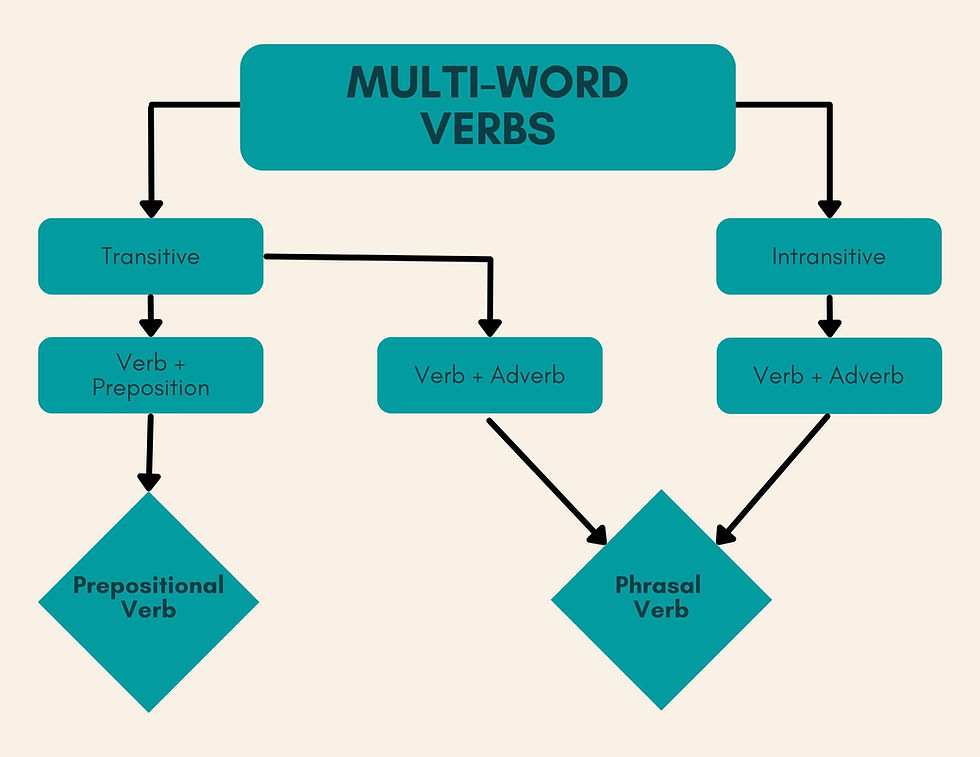
Form: How does the phrasal verb work? Is it transitive or intransitive? If it is transitive, is it separable or inseparable? How is it pronounced and spelled? What words commonly go with it?
Use: How is it used in real English? Is it formal or informal? Who would use it, and in what situation? What other words and expressions commonly occur with it?
The more students understand about a phrasal verb, including its limitations and flexibilities, the more useful it becomes when they want to use it themselves.
So, don't just give students a phrasal verb, its definition, and a translation. Encourage them to explore how it works in real English. That's what helps them move from knowing what a phrasal verb means to being able to use it naturally.
Teach phrasal verbs as the natural choice
Students often try to translate an idea directly from their first language. The result may be grammatically correct English, but it isn't necessarily the expression that an English speaker would naturally choose.
For example:
I rejected the offer.
There's nothing wrong with this sentence. But in everyday English, we might naturally say:
I turned down the offer.
This doesn't mean that a phrasal verb is always better than a one-word alternative. The question is: What would an English speaker naturally choose in this situation?
As teachers, we often correct grammatical mistakes, vocabulary mistakes, and pronunciation, but do we also correct students when their English is correct but could be more natural?
I think this is an area where we can push students a little further.
Students need to know that learning English isn't only about producing grammatically correct sentences. Developing a feel for the language and making choices that are appropriate for the situation is how good learners become great learners.
Give students opportunities and encouragement to use them
Finally, don't assume that recognising a phrasal verb means students will be able to use it.
They need frequent opportunities to practise and use the language.
Short speaking activities, personalised questions, role plays, discussions, and writing tasks can all give students opportunities to use target phrasal verbs.
Start with controlled practice and then give students opportunities to use the language more freely.
For controlled practice, try putting the target phrasal verbs on the board and asking students to aim to use them in their answers.
Then, as students become more confident, give them opportunities to use the language without the prompts. And keep coming back to it. Students need to meet and use new language several times before it becomes part of their active vocabulary.
Putting the five rules together
If you'd like to explore this topic further, I'd love to hear from you. Please don't hesitate to get in touch if you'd like to talk about this or any other teaching challenges.


Comments